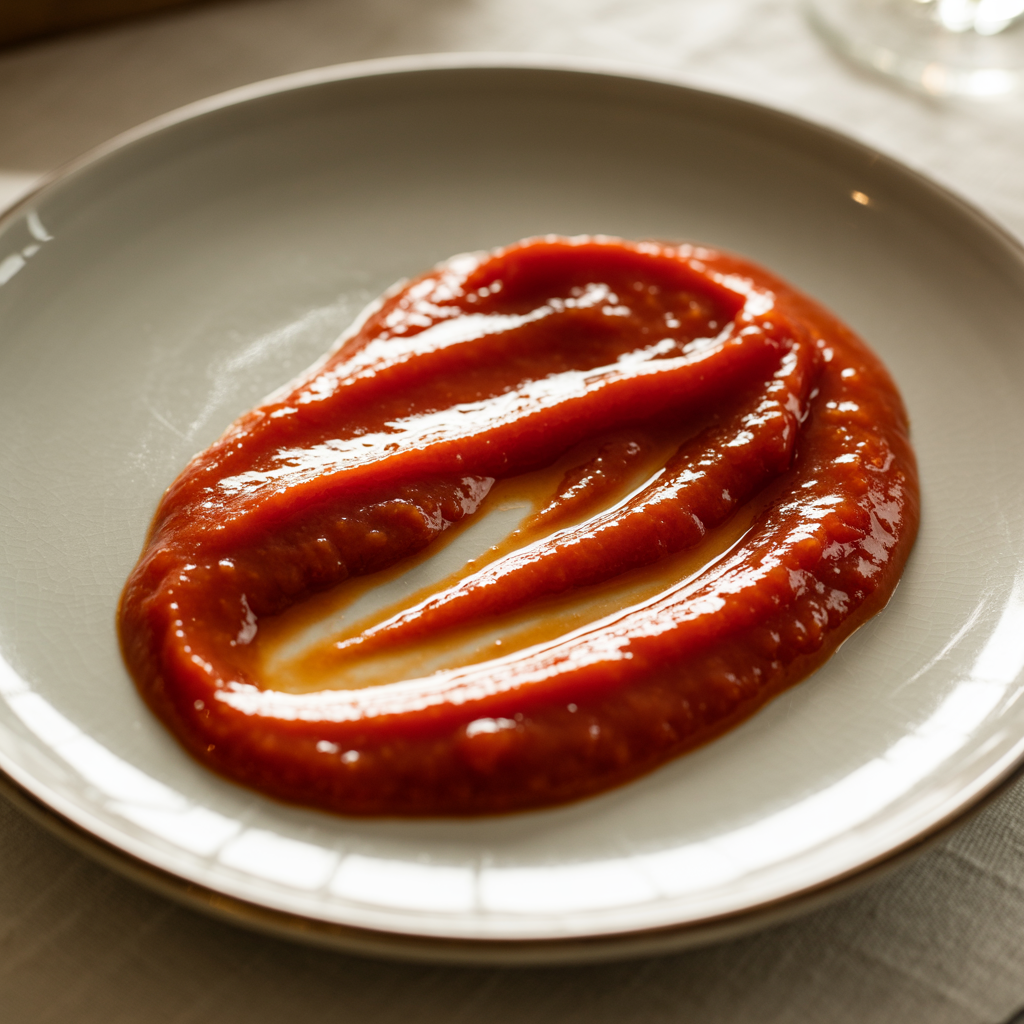
1. The Mathematics of Tomato Paste Reconstitution
In industrial food processing, precision is everything. To calculate how much water is required to break down bulk Double Concentrated Tomato Paste (28-30% Brix) into your target concentration, you cannot rely on guesswork.
Without accounting for additives like salt, sugar, or vinegar, the standard linear dilution formula used by R&D laboratories worldwide is:

Real-World Example:
If your production batch requires you to dilute 1,000 kg of 30% Brix bulk tomato paste down to a standard 10% Brix tomato sauce base, the calculation is as follows:

- The Ratio: 1 part tomato paste to 2 parts water (1:2 ratio by weight).
- The Yield: This batch will yield a total of 3,000 kg of reconstituted tomato sauce base.
Use the interactive tool below to adjust your Brix parameters and instantly calculate the precise water volume required for your recipe.
Tomato Paste Dilution Calculator
Calculate water addition and industrial batch yield based on Brix concentration
2. Standard Reference Ratios for Commercial Food Applications
Different end products require specific viscosities and flavor profiles. While the final recipe depends heavily on your brand’s unique formulation, the table below provides the industry-standard reference baselines for converting 28-30% Brix Double Concentrated Tomato Paste:
| Target End Product | Target Brix Range | Recommended Paste-to-Water Ratio | Technical Processing Note |
| Tomato Ketchup | 24% – 32% Brix | 1 : 0 (Direct Formulating) | Water is rarely added. High-fructose corn syrup, vinegar, and liquid spices provide the necessary moisture. |
| Pizza / Pasta Sauce | 12% – 16% Brix | 1 : 1 to 1 : 1.5 | Both HB and CB tomato paste can be used depending on the formulation. Hot Break is generally preferred when higher viscosity, body, and sauce cling are required, while Cold Break may be selected when brighter color and fresher tomato flavor are prioritized. |
| Tomato Soup / Juice | 5% – 8% Brix | 1 : 3 to 1 : 4.5 | Focuses on smooth flowability and refreshing aroma. High-shear mixing is crucial to prevent phase separation. |
3. Beyond the Ratio: Crucial Factors That Affect Mass Production
CRUCIAL NOTICE FOR PRODUCTION MANAGERS:
Reconstituting tomato paste is not just a matter of adding water. Tomato paste is a complex, non-Newtonian fluid. If your QC team only monitors the Brix level, you risk ruining the texture, Bostwick consistency, and stability of your final product.
Before adjusting your production line, three critical variables must be evaluated:
- Hot Break (HB) vs. Cold Break (CB):Even at the exact same 28-30% Brix and dilution ratio, a Hot Break paste (processed at 85–100°C to preserve natural pectins) will yield a much thicker, high-viscosity sauce than a Cold Break paste (processed at 65–75°C). Choosing the wrong break type will completely alter your product’s texture.
- Shearing and Mixing Equipment:Industrial high-shear mixers break down pectin structures differently than low-speed paddle blenders. The mechanical shear stress directly impacts the final Bostwick viscosity value.
- Water Quality and Temperature:The pH and mineral hardness of your process water can alter both the natural acidity (pH) and the vacuum-holding capacity of the paste during reconstitution.
Industrial Disclaimer & Safe Practice
The dilution ratios and formulas provided in this article serve strictly as theoretical baselines for commercial sourcing and preliminary cost estimation. Because commercial food production involves complex variables—including starch thickeners, stabilizers, hydrocolloids, and varying thermal processes—we strongly advise your R&D and Quality Control teams to perform lab-scale bench tests and pilot runs prior to full-scale commercial manufacturing.
4. Partner with a Technical Tomato Paste Supplier
At Redorafoods , we do not just ship aseptic drums; we deliver predictable consistency. We supply premium 28-30% Brix Hot Break and Cold Break Tomato Paste packed in 220L aseptic bags, complete with full COA (Certificate of Analysis) documentation detailing exact Brix, Bostwick, and color Gardner values.
Need to verify the perfect ratio for your upcoming production run?
[Contact our technical sales team today] to request a complimentary laboratory sample or to discuss custom specification matching with our food technologists.