When evaluating tomato paste ingredients for food manufacturing, culinary applications, or international B2B trade, the ingredient list looks deceptively simple. On a standard retail label, you will often find just one item: Tomatoes.
However, from a food science and industrial procurement perspective, “tomato paste ingredients” encompass a complex matrix of natural soluble solids, organic acids, functional proteins, and strict biochemical parameters.
This comprehensive guide explores the chemical, nutritional, and technical specifications of industrial tomato paste, providing the exact benchmarks required by R&D professionals and global quality assurance (QA) teams.
1. The True Composition of Industrial Tomato Paste
Pure industrial tomato paste is a concentrated product derived entirely from the sound, mature red fruit of Solanum lycopersicum. By international food standards (such as the Codex Alimentarius), true tomato paste contains no added starches, thickeners, or non-tomato sugars. Its entire composition is derived from the separation of skins and seeds followed by the evaporation of water.
Chemical & Nutritional Matrix
- Total Soluble Solids (TSS): Primarily consisting of natural inverted sugars—fructose and glucose in roughly equal parts. These sugars account for the majority of the dry matter and dictate the sweetness and caloric density of the paste.
- Natural Organic Acids: Dominated by citric acid (and to a lesser extent, malic acid). These acids are crucial for maintaining the characteristic tangy flavor profile and, more importantly, keeping the pH level inherently low.
- Lycopene: The core antioxidant carotenoid that gives tomato paste its deep red hue. In technical B2B evaluations, lycopene content ($\text{mg/100g}$) is often used as a non-colorimetric indicator to assess raw material quality and thermal damage during processing.
- Dietary Fiber & Pectins: Water-soluble and insoluble pectins determine the rheological properties (viscosity and texture) of the paste.
- Proteins & Minerals: Includes minor plant-derived proteins and essential minerals such as potassium and trace amounts of endogenous sodium.
2. Technical Specifications & Quality Benchmarks
In global trade and food science, the quality of tomato paste is quantified across four critical dimensions: chemical, physical, microbiological, and contaminant thresholds.
2.1 Chemical & Purity Parameters
+------------------------+-------------------------------------------------------+
| Parameter              | Industry Standard Benchmark                           |
+------------------------+-------------------------------------------------------+
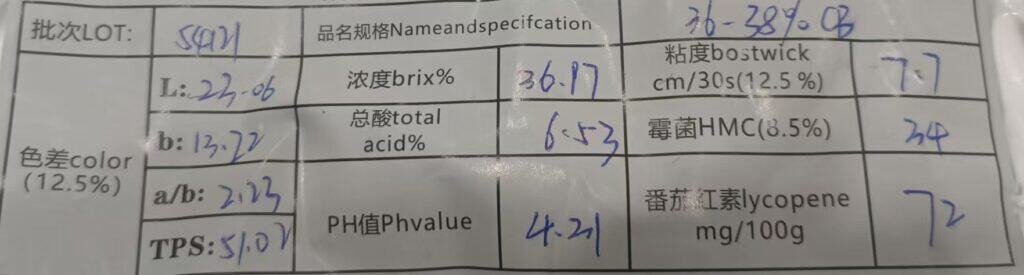
| Brix (Soluble Solids)  | ≥ 24% (Commonly 28-30%, 30-32%, or 36-38% Super Hot)  |
| pH Value               | < 4.6 (Typically tightly controlled between 4.0–4.4)  |
| Total Acidity          | 6.0% – 9.0% (as anhydrous citric acid in dry matter)  |
| Lactic Acid            | ≤ 1.0% of total soluble solids (Dry weight basis)     |
| Mineral Impurities     | ≤ 0.1% (Sand/ash content)                             |
+------------------------+-------------------------------------------------------+
- Brix Level: This is the primary grading metric. Codex standards dictate that a tomato concentrate must have a Brix 24% to be legally classified as Tomato Paste (anything lower is categorized as tomato puree or juice). Higher Brix concentrations like 36-38% are achieved via multi-stage vacuum evaporators for maximum shipping efficiency.
- pH Value: The pH must remain strictly below 4.6 to classify the paste as a low-acid food eligible for commercial sterilization. A lower pH (4.0 – 4.4) naturally inhibits the germination of bacterial spores, such as Bacillus species.
- Lactic Acid Threshold: Excessive lactic acid is a red flag in procurement. If lactic acid exceeds 1% of the dry matter, it indicates that the raw tomatoes underwent micro-fermentation or bacterial spoilage prior to thermal processing.
2.2 Physical & Rheological Properties
Bostwick Consistency (The Break Processing Method)
The viscosity of tomato paste is not driven by artificial additives, but by the thermal manipulation of natural pectins during the “Break” process. It is measured using a Bostwick Consistometer, recording the flow distance (in centimeters) over 30 seconds at a specific temperature and diluted Brix (typically 12.5%).
- Cold Break (CB): Raw tomatoes are chopped and heated to a moderate 65°C to 75°C. This temperature allows endogenous pectolytic enzymes (polygalacturonase and pectin methylesterase) to partially degrade the pectin.
- Bostwick Value: 6.0 – 11.0 cm / 30s
- Characteristics: Lower viscosity, better color retention, and a fresher, fruitier flavor profile. Ideal for tomato juice reconstitution.
- Hot Break (HB): Raw tomatoes are rapidly heated to 85°C to 95°C (or higher) immediately after chopping. This instantaneous heat completely deactivates the pectin enzymes, preserving the long-chain pectin polymers.
- Bostwick Value: 3.5 – 5.5 cm / 30s
- Characteristics: Highly viscous, thick, and cohesive. This is the mandatory choice for formulating commercial ketchup, sauces, and gravies where water syneresis must be avoided.
Tomato Processing Breakdown:
[Fresh Tomatoes] ➔ [Crushing/Chopping]
                       │
                       ├─► Heated to 65-75°C  ➔ [Cold Break] ➔ High Flow / Bright Color
                       │
                       └─► Heated to 85-95°C+ ➔ [Hot Break]  ➔ Ultra-Thick / High Pectin
Color and Defects
- Color a/b Ratio: Measured via spectrophotometers or colorimeters. The ratio of Hunter $a$ (redness) to Hunter $b$ (yellowness) is the industry standard for color evaluation. Top-tier paste requires an a/b 2.1. A lower ratio indicates product browning or caramelization due to overheating in the evaporators.
- Black Specks: Particulate defects (burnt skin, seed fragments, or micro-scabs). High-grade paste restricts black specks to fewer than 6 per 10 grams of paste for sizes between 0.5mm and 1.0mm.
To fully understand how fresh tomatoes are processed into concentrated paste, you can explore our detailed guide on the tomato paste production line
2.3 Microbiological Safety Standard
Industrial bulk tomato paste is packed into aseptic bags within steel drums to ensure years of shelf life without preservatives.
- Howard Mould Count (HMC): The ultimate industry metric for raw material hygiene. HMC measures the percentage of microscopic fields showing presence of mold filaments. A high HMC index implies that moldy or rotten tomatoes were processed. Global standards generally enforce an HMC 30 – 50
- Commercial Sterilization: Samples must pass a 7-to-10-day incubation test at 37°C and 55°C. Any signs of container blowing, significant drop in pH, or viable organism detection indicates a failure in the aseptic line.
- Total Plate Count (TPC): Must be strictly $\le 100 \text{ cfu/g}$, while pathogenic organisms like Salmonella, E. coli, and Staphylococcus aureus must be completely Absent.
2.4 Contaminants & Heavy Metal Thresholds
Adhering to Codex Stan 193-1995 and regional FDA/EFSA regulations, industrial tomato paste must not exceed the following heavy metal limitations:
- Tin (Sn): 200 mg/kg (This threshold is particularly monitored for products packed directly into non-lacquered tinplate cans, where acid interaction can cause leaching).
- Lead (Pb): 1.0 mg/kg
- Arsenic (As): 0.5 mg/kg
Summary for B2B Sourcing
When reviewing a technical specification sheet (Spec Sheet) for tomato paste, remember that the “ingredients” are defined entirely by the engineering parameters of the processing plant:
- If you need a thick sauce or ketchup base, specify Hot Break (HB) Tomato Paste with a high Brix (e.g., 28-30% or 36-38%).
- If you need a bright color and natural tomato aroma for juices or soups, opt for Cold Break (CB) Tomato Paste.
- Always check the HMC and a/b color value to instantly gauge whether the manufacturer utilized fresh, premium crops or over-processed low-quality raw materials.
- If you want to know more about What Determines Tomato Paste Quality? Click here.