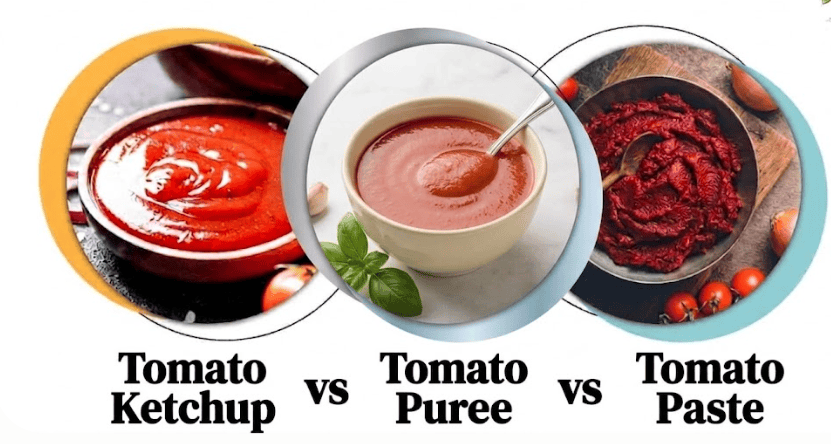
If you’ve ever wondered whether tomato paste, tomato puree, and tomato ketchup are the same product, the answer is no.
Although all three are made from fresh tomatoes, they differ significantly in concentration, ingredients, production methods, and intended use. Understanding these differences is important for consumers, food manufacturers, importers, and distributors alike.
Quick Answer
The biggest difference between tomato paste, tomato puree, and tomato ketchup lies in their concentration and formulation.
- Tomato Paste is a highly concentrated tomato product containing at least 24% tomato soluble solids.
- Tomato Puree is less concentrated and contains between 8% and less than 24% tomato soluble solids.
- Tomato Ketchup is a finished condiment made by blending tomato paste with water, sugar, vinegar, salt, and seasonings.
While tomato paste and tomato puree are commonly used as industrial tomato ingredients or semi-processed tomato products, tomato ketchup is designed for direct consumption.
Tomato Paste and Tomato Puree Are Industrial Tomato Ingredients
Both tomato paste and tomato puree are produced from ripe tomatoes through washing, crushing, refining, and concentration. In the food industry, they are widely regarded as industrial tomato ingredients or semi-processed tomato products because they serve as the foundation for manufacturing numerous tomato-based foods.
Unlike ketchup, they are generally not intended to be consumed directly. Instead, they are used as base ingredients for producing:
- Tomato ketchup
- Pizza sauce
- Pasta sauce
- Cooking sauces
- Soups
- Canned foods
- Ready meals
- Seasonings and other processed foods
For industrial buyers, tomato paste and tomato puree are valuable raw materials that provide flexibility in product formulation and production.
Tomato Paste vs Tomato Puree
Although tomato paste and tomato puree are made using similar production processes, the key difference is their concentration of tomato soluble solids.
This distinction is officially recognized by the U.S. Food and Drug Administration (FDA) under 21 CFR §155.191, which defines the products as follows:
“Tomato puree” or “tomato pulp” if the food contains not less than 8.0 percent but less than 24.0 percent tomato soluble solids.
“Tomato paste” if the food contains not less than 24.0 percent tomato soluble solids.
These FDA definitions are widely referenced throughout the global tomato processing industry and provide a clear technical standard for distinguishing between the two products.
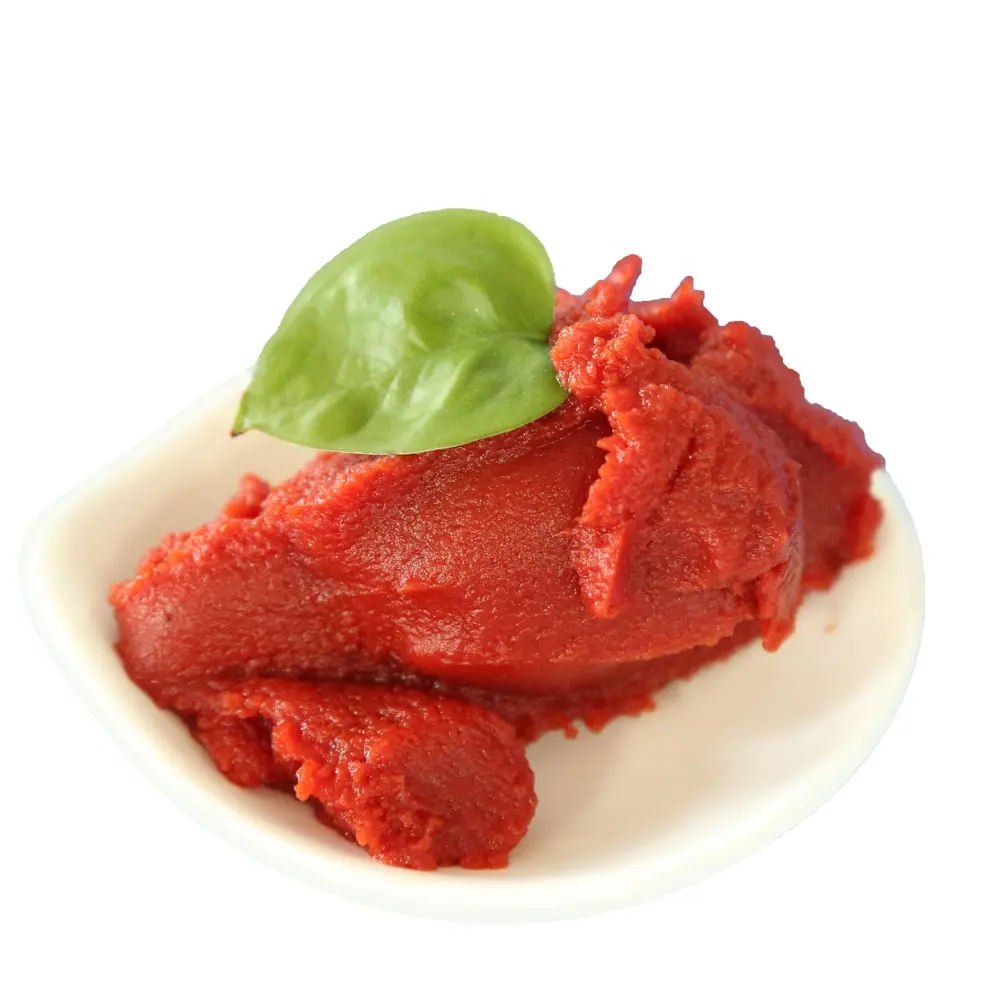
What Is Tomato Paste?
Tomato paste is produced by removing a significant portion of water from refined tomatoes until the product reaches 24% or more tomato soluble solids.
Its characteristics include:
- Thick and dense consistency
- Rich and concentrated tomato flavor
- Deep red appearance
- Long shelf life
- High transportation efficiency due to reduced water content
In international trade, the most common specifications are:
Because of its concentration, tomato paste is widely used as the primary ingredient in food manufacturing.
What Is Tomato Puree?
Tomato puree follows the same basic production process but undergoes less evaporation.
According to the FDA standard, tomato puree contains not less than 8% but less than 24% tomato soluble solids, resulting in:
- A smoother texture
- Higher water content
- A lighter consistency
- A milder tomato flavor
It is commonly used in soups, cooking sauces, prepared meals, and recipes where additional dilution is unnecessary.
Tomato Paste vs Tomato Puree Comparison
| Feature | Tomato Paste | Tomato Puree |
|---|---|---|
| FDA Definition | At least 24% tomato soluble solids | 8% to less than 24% tomato soluble solids |
| Concentration | High | Moderate |
| Water Content | Lower | Higher |
| Texture | Thick and dense | Smooth and thinner |
| Flavor | Rich and concentrated | Milder |
| Typical Use | Industrial ingredient | Sauces, soups, and prepared foods |
Tomato Paste and Tomato Puree vs Tomato Ketchup
Although tomato ketchup is also made from tomatoes, it belongs to a completely different product category.
The major distinction is that:
- Tomato Paste and Tomato Puree are industrial tomato ingredients or semi-processed products.
- Tomato Ketchup is a finished consumer condiment.
Commercial tomato ketchup is typically manufactured by combining tomato paste with additional ingredients such as:
- Water
- Sugar
- Vinegar
- Salt
- Onion powder
- Garlic powder
- Spices
- Flavorings
- Stabilizers or preservatives (depending on local regulations)
The resulting product has the familiar sweet-and-tangy flavor commonly served with French fries, burgers, fried chicken, sandwiches, and snacks.
Unlike ketchup, tomato paste and tomato puree are rarely consumed directly. Instead, they act as the base ingredients used by food manufacturers to produce ketchup and many other tomato-based foods.
From Fresh Tomatoes to Tomato Ketchup: The Production Chain
The relationship between these three products can be understood through a simple production process:
Fresh Tomatoes
        │
        ▼
 Washing & Sorting
        │
        ▼
 Crushing & Refining
        │
        ▼
 Initial Concentration
        │
        ├────────► Tomato Puree
        │          (8% to <24% tomato soluble solids)
        │
        ▼
 Further Concentration
        │
        ▼
 Tomato Paste
 (≥24% tomato soluble solids)
        │
        ▼
 Add Water + Sugar + Vinegar + Salt + Spices
        │
        ▼
 Tomato Ketchup
 (Finished Consumer Product)
This illustrates why tomato paste is often considered the core raw material for ketchup production, while tomato puree represents a less concentrated intermediate product.
Frequently Asked Questions
Is tomato paste the same as tomato puree?
No. Tomato paste is more concentrated and contains at least 24% tomato soluble solids, while tomato puree contains between 8% and less than 24%.
Is tomato ketchup made from tomato paste?
Yes. Most commercial tomato ketchup is produced using tomato paste as its primary ingredient, combined with water, sugar, vinegar, salt, and seasonings.
Which product is considered an industrial ingredient?
Both tomato paste and tomato puree are industrial tomato ingredients and semi-processed products widely used in food manufacturing.
Can tomato paste replace tomato puree?
Yes, but because tomato paste is more concentrated, it usually needs to be diluted with water before being used as a substitute for tomato puree.
Conclusion
Although tomato paste, tomato puree, and tomato ketchup all originate from fresh tomatoes, they serve very different purposes in the food industry.
According to the FDA, tomato puree contains not less than 8% but less than 24% tomato soluble solids, while tomato paste contains not less than 24% tomato soluble solids. This difference in concentration affects their texture, flavor, and applications.
Tomato paste and tomato puree are primarily used as industrial tomato ingredients or semi-processed tomato products, forming the foundation for countless processed foods. Tomato ketchup, by contrast, is a finished condiment created by blending tomato paste with water, sugar, vinegar, salt, and seasonings for direct consumption.
Understanding these distinctions helps consumers make informed choices and enables food manufacturers and importers to select the most suitable tomato product for their specific applications.